
I came to photograph dried fish in a Shutki Palli of Chittagong. I ended up watching hands. Women, men, teenagers and children moved through the same yard, and most of them worked full time. Many worked in families, with the father, the mother and the children on the same platforms. This is the story of the people who make shutki, what a few of them told me, and what I could not tell.
Quick Facts
- Location: Bakalia Bastuhara Shutki Palli, on the Karnaphuli River bank, Chittagong
- My visit: at noon, April 2026
- Peak season: November to February, according to processors
- Common fish: ribbon fish (chhuri), Bombay duck (loitta) and phasa (faisha)
- Yield: about five kilograms of fresh fish make one kilogram of dried fish
- Who works here: women, men, teenagers and children, from what I saw
- Where it goes next: Asadganj wholesale market, known as Shutki Potti
What is a Shutki Palli in Chittagong?
A Shutki Palli is a riverside drying yard where fresh fish becomes shutki, the dried fish Bangladesh loves. Bakalia Bastuhara is one of several along the Karnaphuli River. Reporting from 2020 describes a cluster of processing estates across Bakalia, Ichhanagar, Juldha and Dangarchar.
The peak season runs from November to February, according to processors. One trader in Bastuhara put the drying season at October to March. Processors also say drying continues most of the year, except during the rains. I came in April, after both windows, and the platforms were still full.
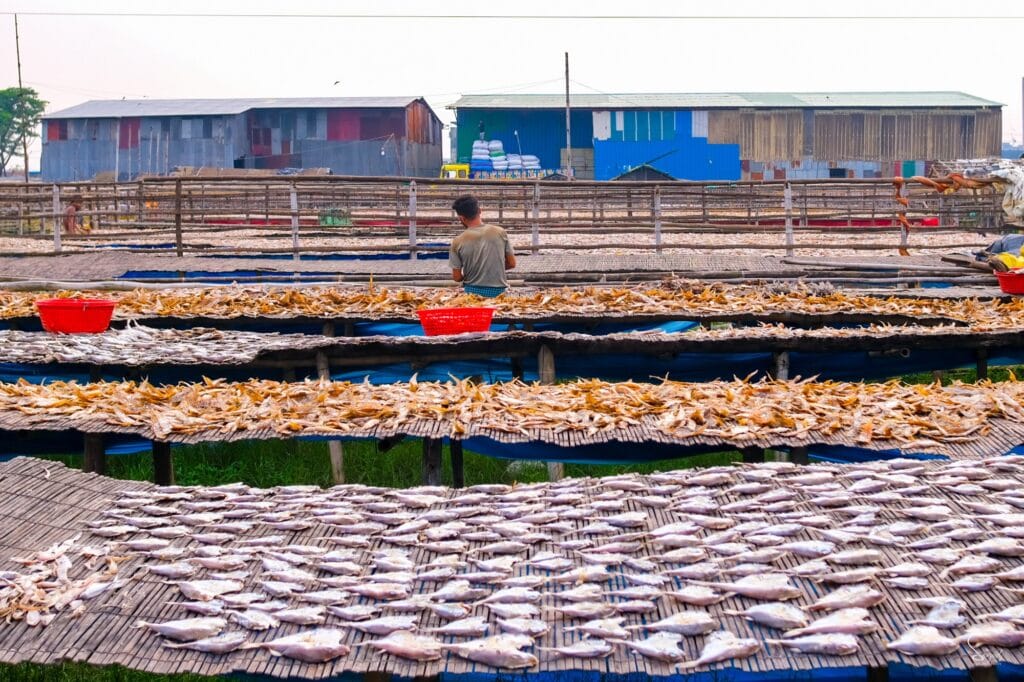
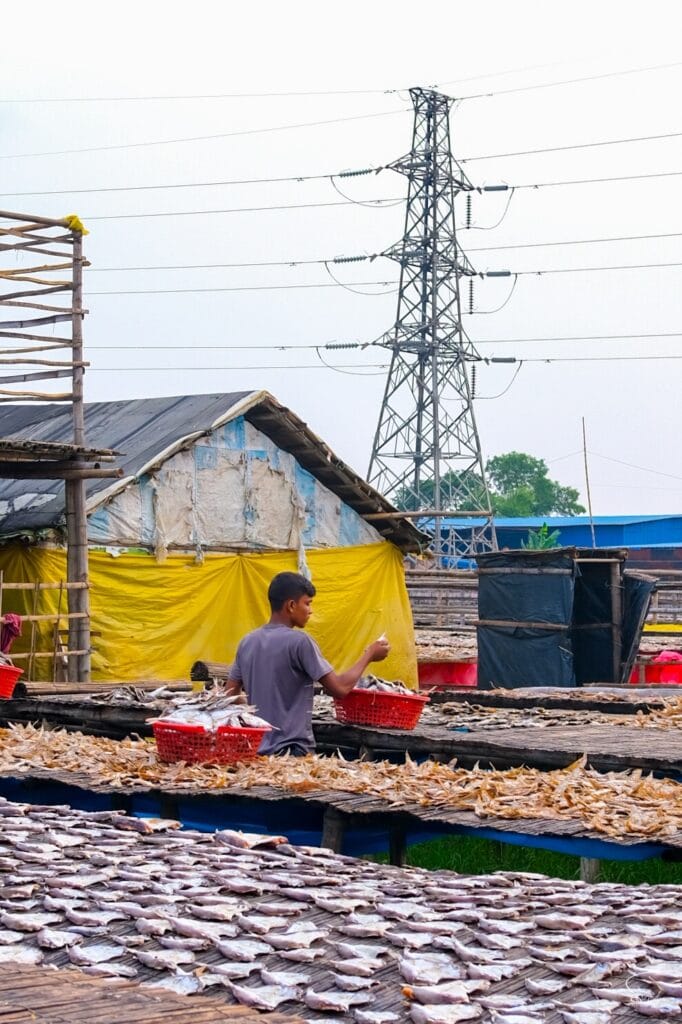
The ground itself is simple. Bamboo platforms rise on posts in long rows. Blue tarpaulin hangs beneath the mats. Tin sheds stand behind, and the city’s apartment blocks show faintly beyond them. I saw no machines doing the work. People carry, cut, spread and sort everything by hand. Most shutki dries under the open sky, and some producers now use greenhouse dryers. One business writer notes a clear difference in taste between the two. At Bakalia I saw open sky and bamboo.
Shutki Palli Chittagong means a string of drying yards along the Karnaphuli River. I reached one of them, Bakalia Bastuhara Shutki Palli, at noon in April. Fish already covered the bamboo platforms, row after row, silver and gold under a flat sky. The yard sits near Notun Bridge.
Where does the fish at Bakalia come from?
Processors say it comes from the Karnaphuli River and the Bay of Bengal. One processor told a reporter he buys his fish at Fishery Ghat, dries it at the palli and sells it to wholesalers at Asadganj. Reporters have counted fifteen to twenty kinds of fish in these yards. Ribbon fish, Bombay duck and phasa are the most common. On my visit I saw rows of small silver fish and long fish that looked like ribbon fish.
Who makes shutki at Bakalia Bastuhara Shutki Palli?
Shutki Palli Chittagong workers include women, men, teenagers and children, and I saw a huge number of women. The workers I talked to told me that many families work here together, with the father, the mother and the children all on the yard. It is a tradition, and it makes the palli feel like a community at work.
In 2020 processors told reporters that about 5,000 people worked at Bakalia. I cannot confirm that number today. The best way to meet them is to follow the fish.
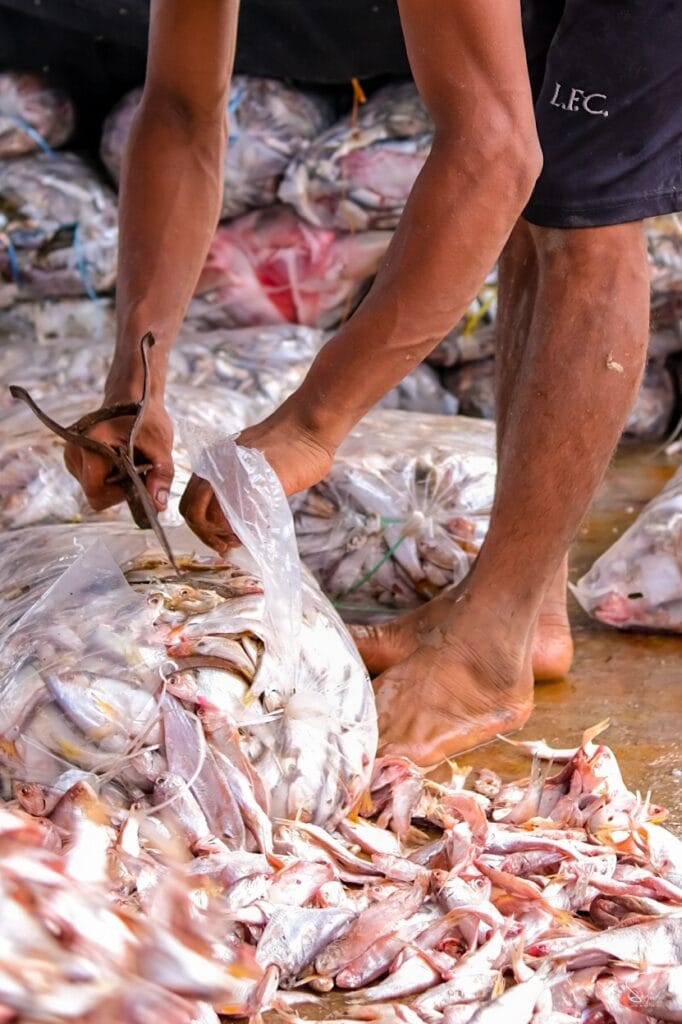
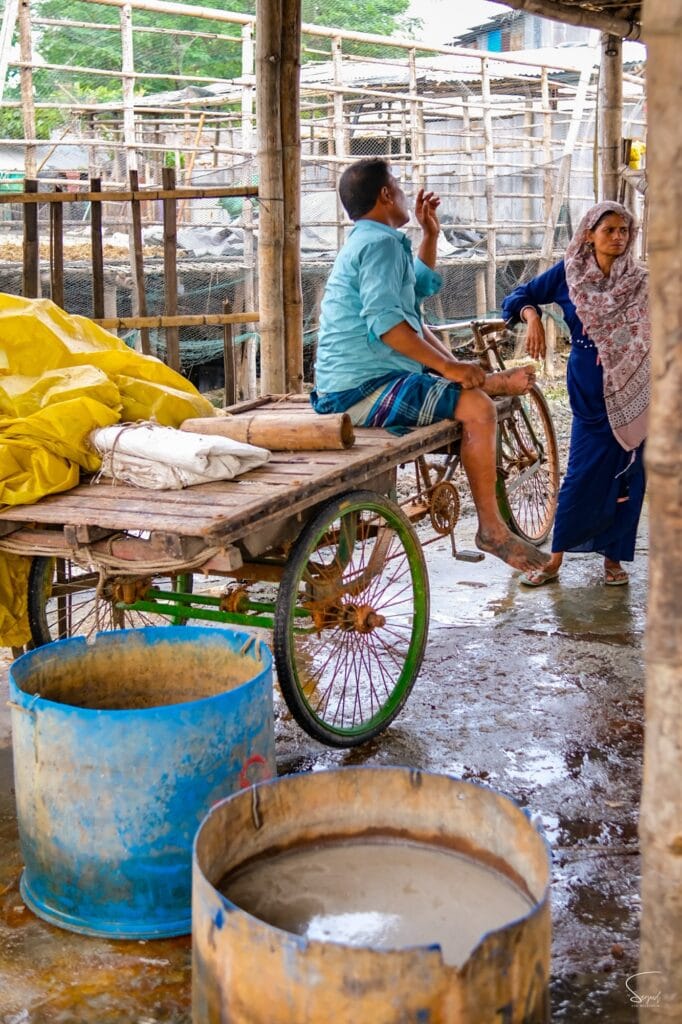
It starts on a wet floor. Raw fish spilled from plastic bags, and a worker stood barefoot in the pile.
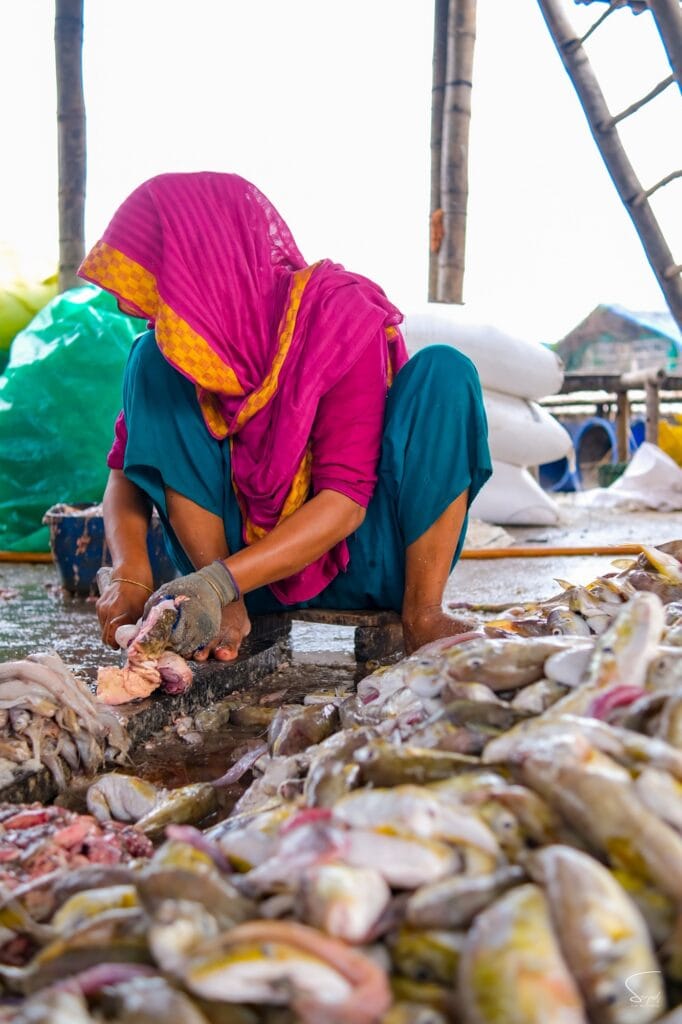
Nearby, a woman sat on a low wooden seat and cut fish by hand, her scarf pulled over her face and a glove on one hand. Gutted fish lay piled around her. Studies of fishing communities in Chattogram and Cox’s Bazar find that men mostly fish while women mostly process. That means the sorting, cutting and drying. One preprint says women’s part in the sector gets little recognition. At Bakalia, their part was plain to see.
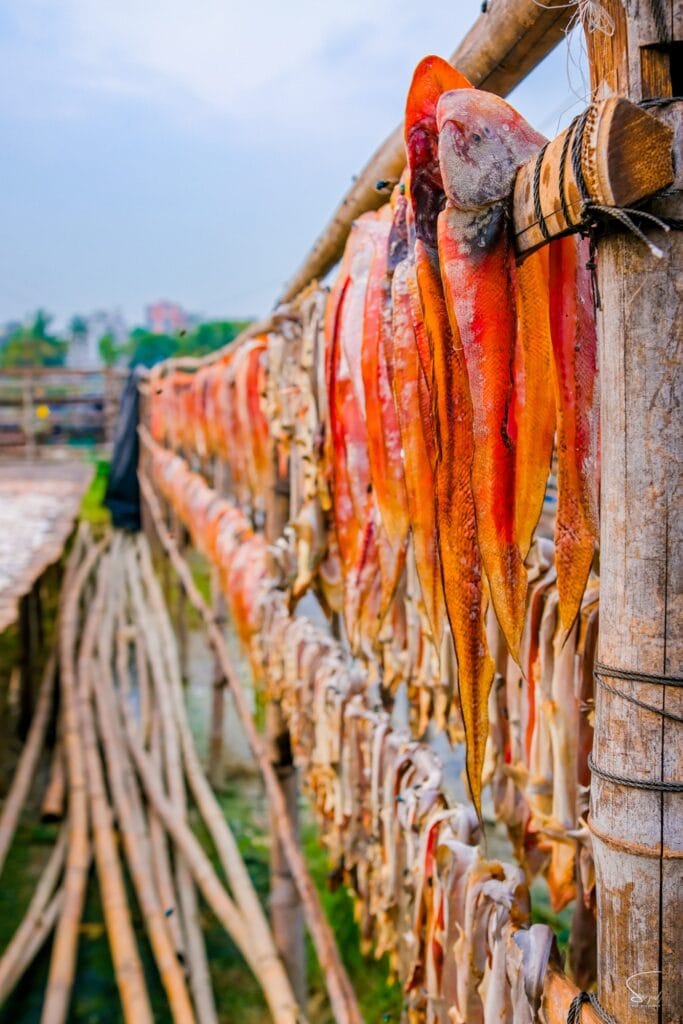
Then the fish goes up. Red plastic baskets sat along the platforms, and workers laid the fish across the mats one by one. Larger fish hung from bamboo poles. On one rack they glowed orange. On another they hung dark brown.
When it dries, someone sorts it. A man in a yellow shirt worked through dried strips on a mat. A gloved hand held up a bunch of what looked like ribbon fish.
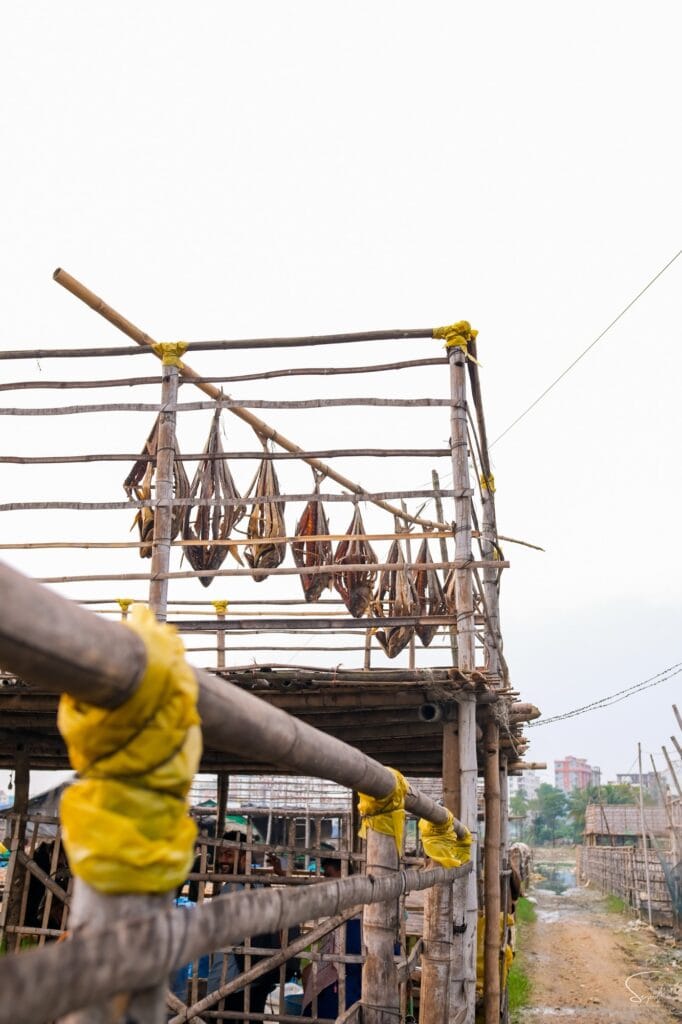
Reporters who visited the palli describe the same steps: washing, salting, slitting the fish and pulling out the entrails, then spreading it on mats or hanging it from poles. A district fisheries officer says about five kilograms of fresh fish make one kilogram of dried fish. That is a lot of hands for every kilogram.
What do workers at the Shutki Palli say about their work?
Some talked, and many did not. Before we photographed anyone, we asked for permission. The workers who talked asked where we came from, and some asked whether we were from a newspaper. We told them we are independent photographers.
The women and teenagers mostly avoided talking. I did not expect anything else from a stranger with a camera.
I took the newspaper question seriously. People who let you photograph them deserve to know who is asking and where the pictures will go. I answered plainly, and I have tried to keep that promise in this post.
Do children work at Bakalia Bastuhara Shutki Palli?
Yes. I saw children and teenagers working full time, next to adults. In many cases, these children are deprived of schooling. A child who works a full day on the platforms cannot also sit in a classroom.
The environment is not comfortable for them either. The floors were wet. Raw fish lay piled on them, and some workers stood barefoot in it. Nothing about the yard was built with a child in mind.
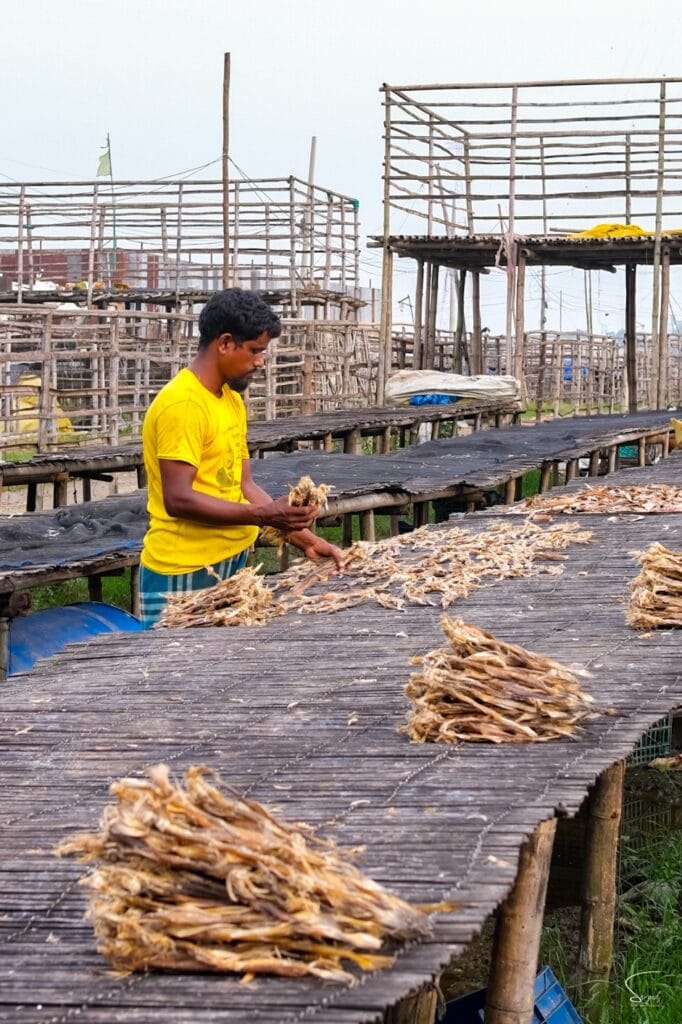
I judged who is a child or a teenager by how they looked, and a photograph cannot prove an age. So I describe what they did and leave the labels to others.
Bangladesh’s Labour Act sets 14 as the minimum age for permissible work and bans hazardous work under 18. The ILO says the country prohibits hazardous work for anyone below 18. I do not know whether shutki processing counts as hazardous under that law. I am not a lawyer, and I am making no legal claim.
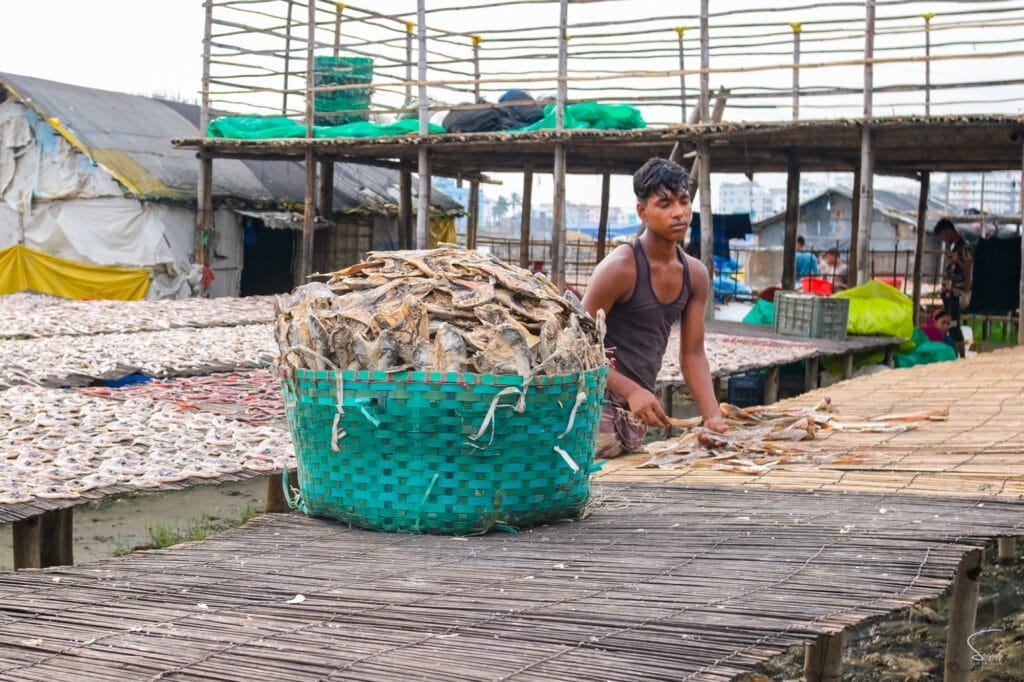
Workers told me that in many families the parents and children work together, so many of these children work beside a parent. That is not the same story as a child sent to work alone. It is also not a child in school.
What does Shutki Palli Chittagong work cost the people doing it?
The work costs them wet floors, uncertain pay and a river under strain. I saw the first with my own eyes. The floors were wet. Some workers stood barefoot among the fish. A few wore gloves. An electricity pylon stood over one corner of the yard. A woman worker told a Sun News reporter that the salt burns and cracks the skin on her hands.
Pay is harder to pin down. In 2020 processors said temporary workers earned Tk250 to 300 a day, and permanent workers Tk8,000 to 12,000 a month. In a later Sun News feature on Bastuhara, a woman worker put her pay at Tk400 to 500 a day. Another worker said drying stops when the rains come, and workers then look for other jobs. I cannot confirm any of these figures today. Processors also said imports hurt them. One said imported ribbon fish shutki sold for Tk500 to 600 a kilogram, well below the local price, and that processors get no bank loans.
Chemicals are another question. A review on PubMed Central reports DDT in dried fish sampled from Dhaka and Chittagong markets, with the highest readings in Bombay duck. A separate study of producers in Patuakhali and Barisal found they rarely used DDT or similar insecticides. The evidence is mixed. I saw nothing at Bakalia that showed what, if anything, was applied to the fish. I am not claiming this palli uses any chemical.
The river sits beside all of it. University of Chittagong researchers found microplastics in the Karnaphuli’s water and sediment. A 2020 survey by a local river protection group found the river near Shah Amanat Bridge had narrowed to 510 metres at high tide, from 886 metres before. One Bastuhara trader told a reporter that pollution affects fish quality, and that drying takes longer now because sunshine is less steady.
Where does Chittagong dried fish go after drying?
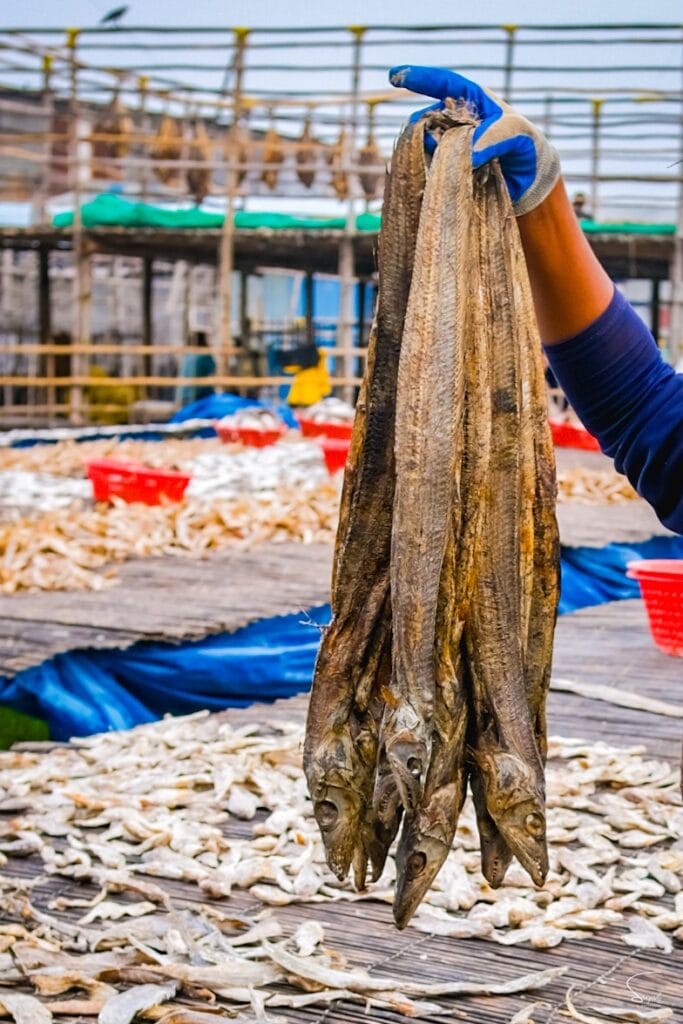
Processors say the dried fish from Shutki Palli Chittagong yards goes to Asadganj, the largest wholesale dried fish market in Bangladesh. People call it Shutki Potti. Traders there supply shutki across the country. One Bastuhara trader said most of it goes to Cox’s Bazar, Sylhet and Dhaka. Wholesalers also told reporters that consignments go abroad, including to the Middle East, the US and the UK. I cannot confirm those volumes.
Traders say the fish comes fresh from the Karnaphuli and the Bay of Bengal, and that gives Chittagong shutki its taste. A customer in Bastuhara told a reporter the taste from this area is special. That is opinion, and I cannot test it. Before any of it reaches a shop, the hands in these photographs have handled it.
What did the Shutki Palli teach me as a photographer?
That a photograph of work is not the same as knowing the work. I came for a story about fish. I left thinking about families, and about what I owe them.
So I made choices. I did not keep the faces of the youngest workers out of the frames that lead this post. I wrote what I saw and what the workers told me, and nothing else. Where I do not know, I have said so.
Another working place raised the same question for me, on the Mahananda River, in Where the River Gives Stone, my essay on the stone lifters of Tetulia. You can see more of my work with people in my street photography.
I do not know yet what these photographs give back to the people in them. I know they should not take more than they show.
Frequently asked questions
What is a Shutki Palli?
A Shutki Palli is a riverside yard where fish is cleaned, salted and dried in the sun to make shutki, or dried fish. Chittagong has several along the Karnaphuli River, including Bakalia Bastuhara.
When is the best time to see shutki drying in Chittagong?
Processors say drying continues most of the year except during the rains. The peak season runs from November to February.
Where does Chittagong dried fish go after drying?
Processors say most of it goes to Asadganj, the large wholesale dried fish market in Chittagong, known as Shutki Potti. Traders there supply shutki across the country.
Discover more from sayeedbm.com
Subscribe to get the latest posts sent to your email.