
“A camera teaches you how to see without a camera.“
–Dorothea Lange
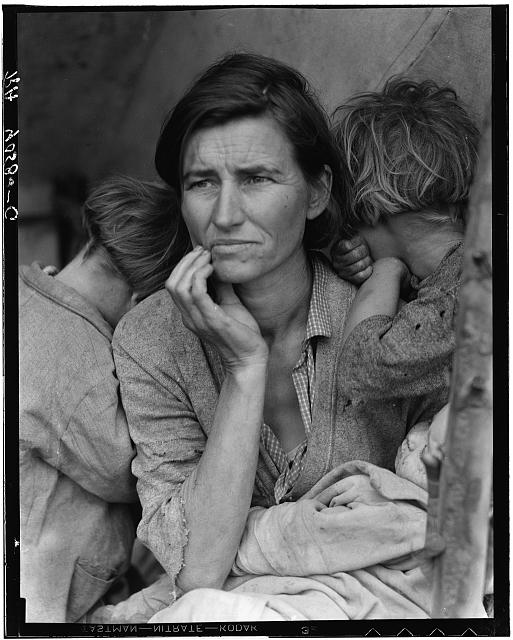
She is thirty-two years old. Her children press into her sides, faces turned away from the camera. One hand rests against her jaw. She does not look at you. She looks past you, past the photographer, past the pea-picker’s camp in Nipomo, California; toward something only she can see.
That gaze has not aged a day since 1936.
Migrant Mother is one of the most reproduced photographs in human history. It appeared on postage stamps, in museum collections, in school textbooks on every continent. A single frame that moved a government to act within 72 hours and yet the woman inside it spent forty years as the world’s most recognizable anonymous face.
What the Frame Actually Shows
Two children press against their mother, faces buried in her shoulders. That one detail concentrates everything onto her face, there is nowhere else for your eye to go. Her hand rests against her jaw in a gesture of worry so universal it crosses every cultural boundary. The tent behind her is suggested rather than shown. The baby in her arms barely registers.
Lange arranged no props and directed nothing on this shoot; except, according to Thompson’s children, she asked them to lean in closer. That single instruction produced a composition echoing centuries of Madonna and Child iconography. The viewer feels not just sympathy but something older: a duty of care.
Her eyes carry the photograph. She is not asking for help. She is somewhere past asking.
The Woman Behind the Lens
Dorothea Nutzhorn was born in Hoboken, New Jersey in 1895. At seven, she contracted polio, leaving her with a permanent limp. At twelve, her father walked out. Her mother took back her maiden name, Lange and Dorothea took it too.
Those two early losses shaped everything that followed. She understood, from childhood, what it meant to be marked by circumstance and overlooked by the world.
She trained in photography in New York and opened a portrait studio in San Francisco in 1918. For over a decade she photographed the wealthy, the successful, respected, and increasingly restless. The 1929 market crash emptied her client list and filled the streets outside her studio with the unemployed. One day she walked out with her camera and did not come back the same photographer.
By 1935, the US government’s Farm Security Administration had hired her to document the human cost of the Great Depression. Her assignment was to bear witness, to make Washington feel what the fields were living.
The Ten Minutes That Changed Everything
It was February 1936. Lange was driving home after a month-long assignment, ready to be done. Near Nipomo, she passed a roadside sign for a pea-picker’s camp. She drove on twenty miles. Then, following instinct over reason, she turned back.
The pea crop had frozen. Around 2,500 workers had no income, dwindling food, and nowhere to go. She walked in and found Florence Owens Thompson; thirty-two, widowed, a Cherokee woman from Oklahoma, mother of seven. Her family had been surviving on frozen vegetables and birds the children caught. She had sold the tyres from her car to buy food.
Lange made five exposures in ten minutes, moving closer with each frame. She did not ask Thompson’s name or her history. Thompson asked no questions either. Lange later wrote there was a kind of equality between them. Thompson seemed to understand the photographs might help her, and so she helped Lange.
Lange left and never returned to Nipomo. She sent the photographs to a San Francisco newspaper, which published them within days. The government sent 20,000 pounds of food and $200,000 in aid to the camp within 72 hours of publication.
By the time the trucks arrived, Thompson and her seven children were already gone, drifted to the next farm, the next county, the next crop. The photograph had moved a nation. The woman in it had moved on, unknown.
Two Photographs Most People Have Never Seen
White Angel Breadline, San Francisco | 1933
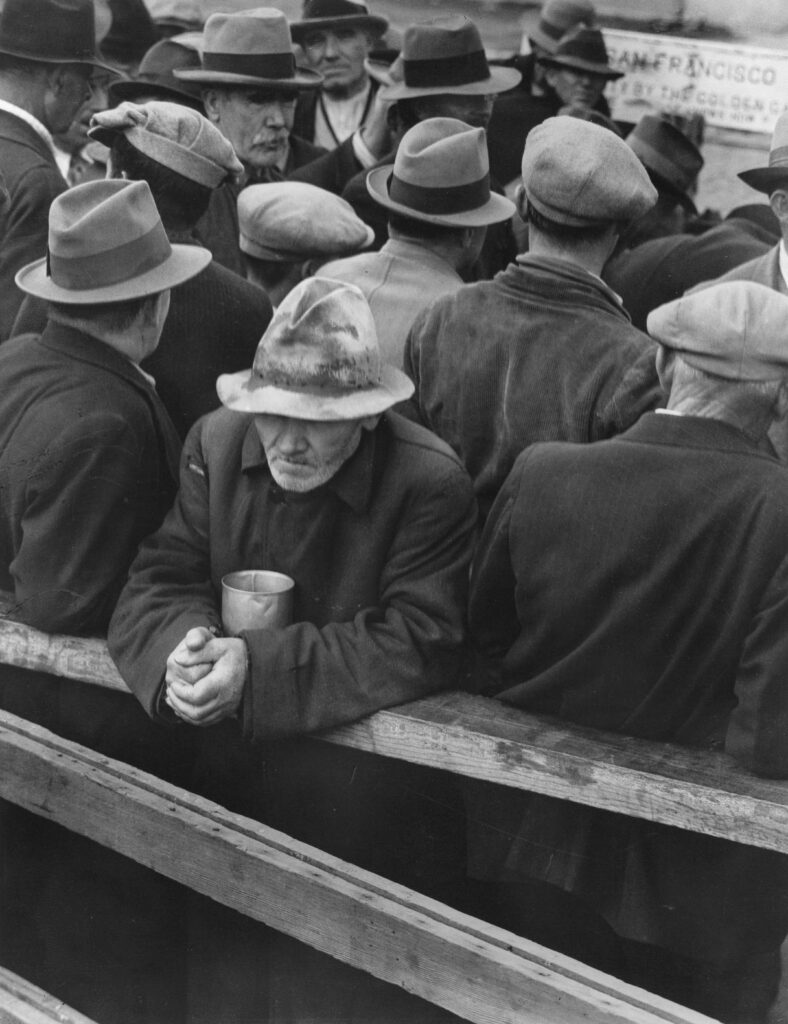
Three years before Migrant Mother, Lange walked out of her portrait studio for the first time with a camera. She went to the White Angel Jungle, a San Francisco soup kitchen, and photographed a lone man at a food line, back turned to the crowd, chin down, hat brim hiding his face, hands wrapped around a tin cup.
This was her first street photograph. She was nervous her large camera would frighten people away. Nobody noticed her. This man certainly didn’t. He stood apart from everyone else, turned inward, anonymous in a sea of the anonymous.
She would spend the rest of her career chasing that quality: the person who reveals everything precisely because they are not performing for the lens.
Pledge of Allegiance, Raphael Weill School, San Francisco | 1942
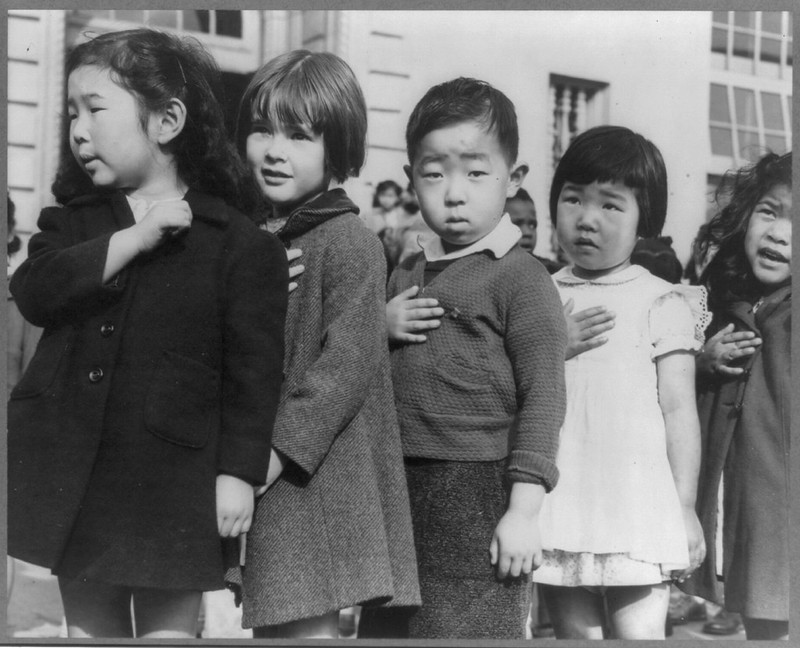
In 1942, the US government hired Lange to photograph the forced evacuation of Japanese Americans to internment camps. She opposed the policy. She took the assignment anyway, believing honest documentation was the most powerful form of protest available to her.
This photograph shows first-grade children at a San Francisco school, hands on hearts, reciting the Pledge of Allegiance. Within weeks, the Japanese American children in this frame were removed from their school, their neighborhood, their city, sent to camps in the desert.
The military commanders who reviewed Lange’s internment work understood exactly what she was doing. They seized the photographs for the duration of the war. Some prints came back stamped with a single word: Impounded. They remained largely unseen for over sixty years.
Why She Still Matters
Florence Owens Thompson spent four decades as the world’s most recognisable anonymous face. When a journalist found her in 1978, she was living in a trailer in Modesto, California. She felt exploited. Her children disputed Lange’s account of the encounter. She had never consented in writing. She had never received a cent.
In 1983, dying of cancer and unable to afford her medical bills, her children revealed her identity to the press. The public sent $35,000 in donations. She died that September.
Dorothea Lange died in 1965, the same year a major retrospective of her work opened at the Museum of Modern Art in New York. She spent her final months completing it, knowing she was dying, choosing to let the work outlast her.
She was right to trust it. Migrant Mother remains among the most consequential photographs ever made, not because it is beautiful, but because it did something. It changed policy. It redirected resources. It forced a nation to look at something it preferred not to see.
But it also left every documentary photographer with a question that has no clean answer: when you press the shutter, who are you serving?
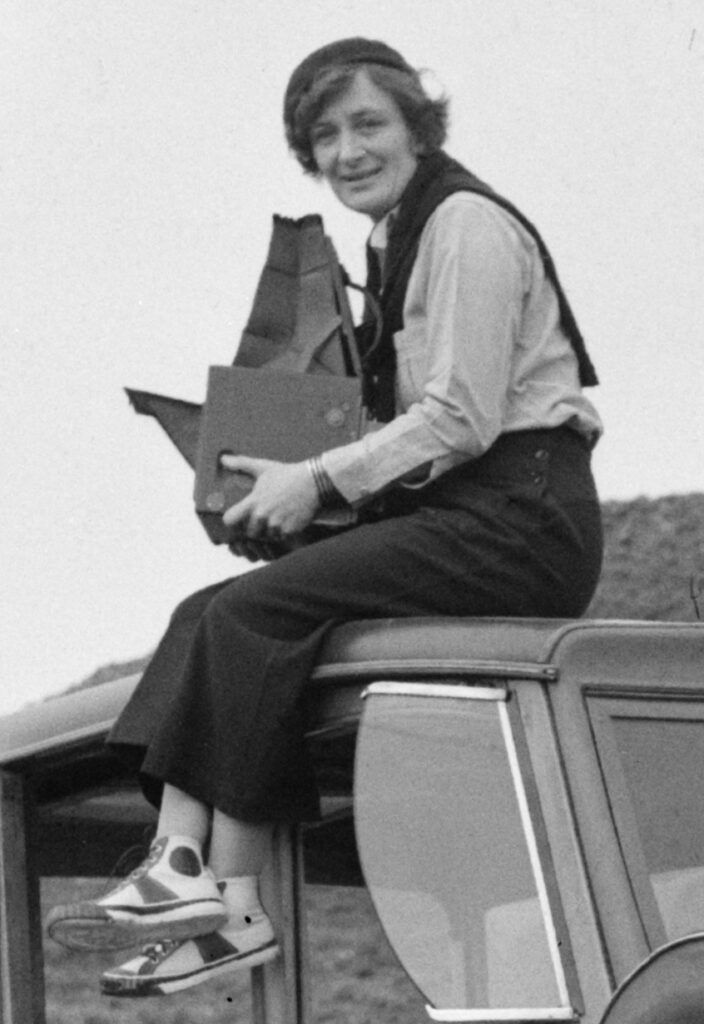
Dorothea Lange (1895–1965) was an American documentary photographer and photojournalist. Migrant Mother (1936) is held in the permanent collection of the Museum of Modern Art, New York, and the Library of Congress, Washington D.C.
If this series interests you, read the previous post on Henri Cartier-Bresson and the Decisive Moment.
Discover more from sayeedbm.com
Subscribe to get the latest posts sent to your email.