
“I consider what I do with the person I shoot a covenant. They present themselves to me, and I treat them with dignity. I refuse to violate that trust.”
-JIM Marshall
San Quentin State Prison, February 1969. Johnny Cash is mid-performance, surrounded by inmates, television crews, and a small crowd of photographers kept at a careful distance. All of them, except one.
Jim Marshall is standing close enough to touch the stage. He raises his camera one more time. Cash looks directly into the lens and raises his middle finger.
The shutter clicks. Marshall doesn’t flinch. He never did.
That single frame would go on to become one of the most reproduced images in music photography history printed on t-shirts, posters, album art, tattooed onto strangers who never knew the man who took it. But the photograph was never really about the gesture. It was about the fact that Cash trusted Marshall enough to make it in the first place. That, more than any technique, is the lesson that has shaped how I shoot concerts in Dhaka.
Why That Frame Still Works
Strip away the rebellion and look at the composition. Cash stares directly down the barrel of the lens no posing, no second take, no publicist hovering at the edge of frame telling him to soften it. The image is sharp, unstaged, lit only by what was already on stage.
That rawness is the entire signature of Marshall’s career. He didn’t create moments. He got close enough, and stayed trusted enough, that the moment simply happened in front of him.
Photograph by Jim Marshall
Johnny Cash
San Quentin State Prison · 1969
View the original photograph →The Photographer Nobody Saw Coming
James Joseph Marshall was born in Chicago in 1936 to Assyrian parents who had emigrated from Iran. His family moved to San Francisco when he was two, and shortly after, his father left. AOL
He grew up an outsider in a city that hadn’t yet become the cultural capital it’s remembered as. As a first-generation Assyrian-American coming of age in 1950s California, Marshall always felt like he was on the outside looking in, and growing up without a father left him struggling with deep issues of abandonment. Wikipedia
In 1959 he bought a Leica and began photographing jazz musicians in San Francisco’s North Beach, completely self-taught. He didn’t study photography. He didn’t apprentice under anyone. He simply showed up to the clubs night after night, camera in hand, until the people in the room stopped noticing he was there. Places Journal
That instinct; ‘Earn the trust first, the photograph follows’ would define every frame he made for the next five decades. It’s also the first real lesson hiding inside his archive: technical skill gets you in the room, but trust is what gets you the photograph.
The Access No One Else Got
By the mid-1960s, Marshall wasn’t just photographing musicians. He was embedded in their lives.
He was the official photographer for the Beatles’ final paid concert at Candlestick Park in San Francisco, and he was head photographer at Woodstock. AOL
Photograph by Jim Marshall
The Beatles’ Final Paid Concert
Candlestick Park, San Francisco · 1966
View the original photograph →At the 1967 Monterey Pop Festival, he captured Jimi Hendrix smiling down at his flame-engulfed guitar, a single frame that came to define not only Hendrix, but the entire festival and the gilded age of rock itself. Places Journal
Photograph by Jim Marshall
Jimi Hendrix Burning His Guitar, Monterey Pop Festival, 1967
View the original photograph →He toured with the Rolling Stones, was backstage with Janis Joplin and Hendrix, and was chosen personally by Johnny Cash to photograph his recordings at Folsom and San Quentin. HISTORY
What made this possible wasn’t luck. It was a rule he never bent. “No lighting, no hair and makeup, none of that crap,” he’d snap at anyone who tried to stage a shoot for him. Publicists had to leave the room. Nobody told him what he could and couldn’t shoot. Grokipedia
“It was kind of known you were taking pictures for publication,” he once said. “And they just let you.” Grokipedia
That’s the second lesson: the less you interfere with a moment, the more access you’re given to the next one.
What This Taught Me, Shooting Concerts in Dhaka
There’s a lesson in Marshall’s work that took me years of shooting in Dhaka to fully understand: the camera is never the thing that gets you the photograph. The trust does.
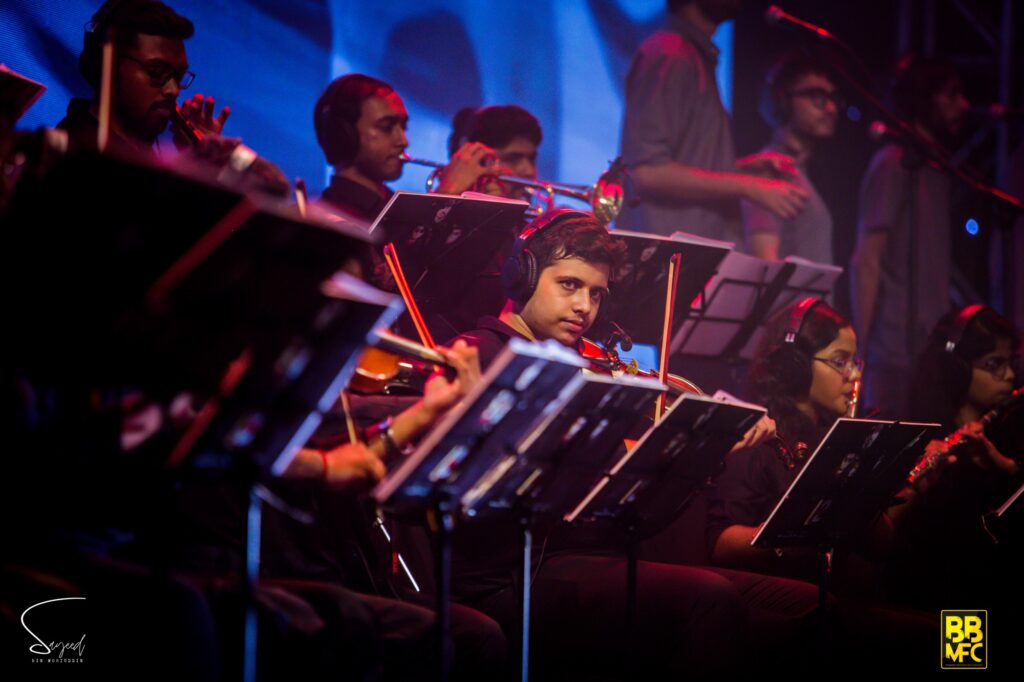
Every concert photographer knows the temptation to chase the obvious moment. The leap, the guitar smash, the crowd singalong. Marshall rarely chased those. He waited for the artist to forget he existed. The best frame in his archive isn’t usually the loudest second of the show. It’s the quiet one; the sound check nobody photographs, the backstage minute before anyone is performing for anyone.
That’s the discipline I try to carry into my own concert photography in Dhaka. A concert photograph isn’t proof that you were close to the stage. It’s proof that, for one frame, the person on stage stopped being aware of you.
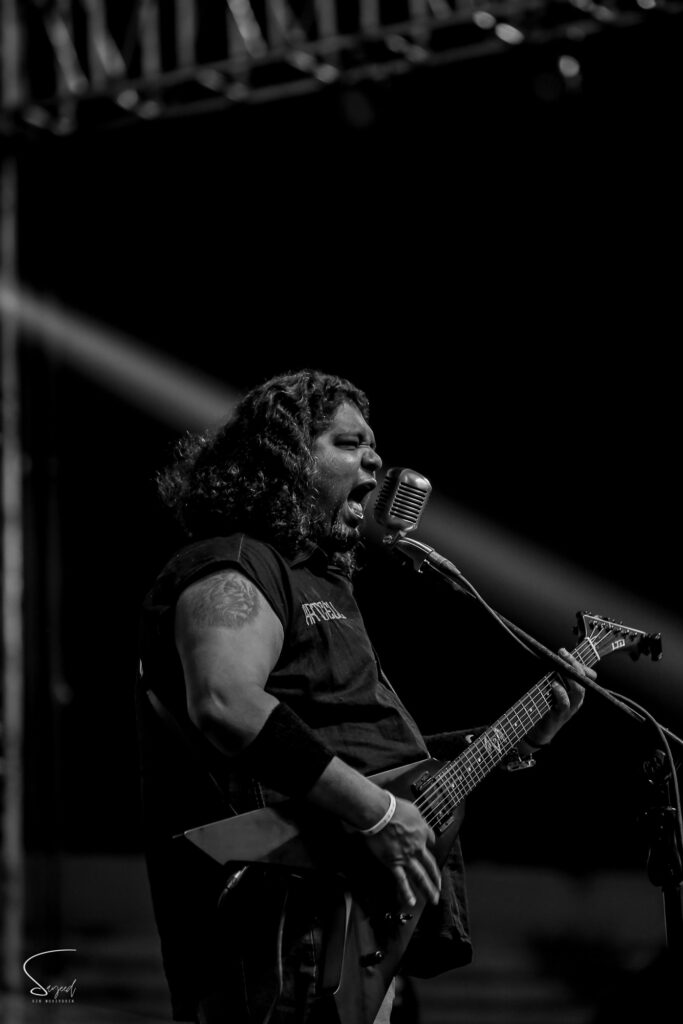
You can see it in the difference between a photo of someone performing and a photo of someone disappearing into the performance. Marshall spent fifty years chasing the second kind. So do I.
The Man Behind the Camera
The trust Marshall earned from his subjects rarely extended to himself.
Growing up without a father, he struggled with deep issues of abandonment and turned to alcohol, drugs, guns, and fast cars to deal with his rage and grief. In 1983 he was arrested on a gun charge and did work release to avoid prison time. Those close to him describe a man who could be volatile and exhausting one moment, and disarmingly tender the next. WikipediaMSN
He never had children. “I have no kids,” he used to say. “My photographs are my children.” AOL
It wasn’t an exaggeration. His longtime assistant Amelia Davis, who worked with him for thirteen years before his death and inherited his estate, said his life was his photography — nothing else came close. Places Journal
Legacy
Marshall died in 2010 at the age of 74. In 2014, he was posthumously awarded a Trustees Award at the Grammys; the first and, at the time, only photographer ever to receive one. AOL
Over the course of his career, his photographs appeared on more than 500 album covers, alongside iconic and candid portraits of Janis Joplin, Jimi Hendrix, Johnny Cash, Bob Dylan, the Grateful Dead, and the Beatles, among countless others. New Times San Luis Obispo
He never staged a single one of them. He simply stood close enough, and stayed trusted enough, that the moment happened anyway.
I think about that every time I raise my camera at a show. The photograph nobody else could take is the one only you were close enough to be given and being close enough is never about the lens. It’s about whether the person in front of you has forgotten you’re holding one.
Jim Marshall (1936–2010) was an American photographer and photojournalist, widely regarded as one of the defining music photographers of the twentieth century. His archive is managed by Jim Marshall Photography LLC. To view his complete body of work, visit jimmarshallphotographyllc.com.
Discover more from sayeedbm.com
Subscribe to get the latest posts sent to your email.